Helping design and engineering professionals discover, evaluate and specify technologies and processes that shorten the design cycle and enable success.


Alert!
Digital Engineering ceased publication on July 1, 2026. This website remains available as an archive of engineering content.
For inquiries or information, please email [email protected].

May 2026 Special Focus: Artificial Intelligence in Design and Simulation
In this Special Focus Issue, learn about the latest developments in the integration of artificial intelligence into engineering workflows.

Design & Simulation Software Guide 2025
In this Special Issue, Digital Engineering presents its second annual guide to design and simulation software vendors.
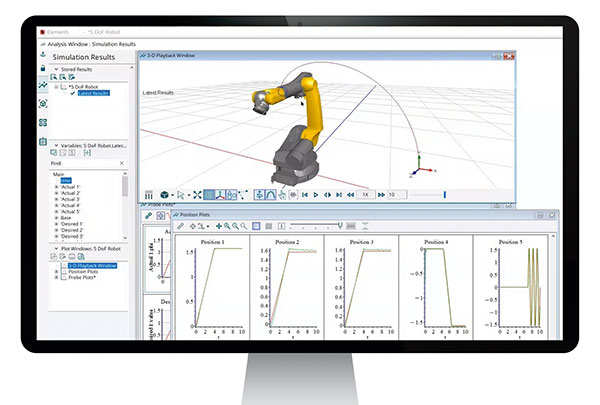
Hexagon's Manufacturing Intelligence division has introduced Elements, new simulation software that helps engineering teams understand system behavior, given complexities of modern products, the company says. Using the software, teams can evaluate the performance and feasibility of new design concepts quickly to inform more efficient product development, according to the company.
Elements addresses integrated, multi-disciplinary system development and end-to-end workflows. Achieving this requires the integration of all relevant engineering disciplines, control systems and third-party supplier systems to understand how the domains interact, and how a design decision in one discipline impacts others.
Systems engineers can easily learn to use the Elements software, using its drag-and-drop environment to model any physics type or logic and analyse systems by intuitively connecting blocks—regardless of whether they represent electrical, hydraulic, mechanical components—to solve system-level engineering problems. It is based on the Modelica language, an open and widely used standard for building fast, flexible and customizable models.
Elements helps speed up engineering development because it ensures that system-level models compute quickly and efficiently by optimizing equations and code for fast calculation, but with no loss of fidelity, Hexagon reports.
As the design develops, and components and subsystems are detailed in specialist simulation software, the components can be routinely integrated into a larger system through full compliance with the FMI standard and Hexagon's SmartFMU technology. SmartFMU unlocks the functional mock-up unit (FMU) for supported Hexagon products so that changes can be made directly in the Elements system-level model without returning to the specialist computer-aided engineering (CAE) software and its user.
At launch, the software provides SmartFMU connectivity with Adams multibody dynamics software and Easy5. Future plans are likely to include workflows with Cradle CFD thermal-fluid dynamics and Actran acoustic simulation products, according to the company.
Standard FMI support and the novel SmartFMU plug-and-play capabilities, according to Hexagon, help address challenges of system complexity, including those for transportation electrification; for example:
Elements was developed in close cooperation with Maplesoft, building upon its math engine to optimize system equations and deliver efficient simulation to Hexagon's customers.
"Elements offers engineers an easy way to explore behaviour of systems quickly and find better solutions to problems using simulation, before committing designs to subsequent resource-intensive engineering processes," Mahesh Kailasam, general manager for Design and Engineering Software at Hexagon, comments. "We look forward to a long-term collaboration with Maplesoft, using its powerful and open technology foundations to realise synergies with our extensive Hexagon CAE ecosystem portfolio and deliver valuable capabilities to our customers."
To learn more about Elements, visit hexagon.com/products/elements.
Sources: Press materials received from the company and additional information gleaned from the company’s website.


Hexagon Manufacturing Intelligence helps industrial manufacturers develop the disruptive technologies of today and the life-changing products of tomorrow. As a leading metrology and manufacturing solution specialist, our expertise in sensing,…

DE's editors contribute news and new product announcements to Digital Engineering. Press releases may be sent to them via [email protected].
Follow DE






About Us · Contact Us · Editorial Team · Advertising · Privacy Policy · Subscriber Services · © 2026 Digital Engineering 24/7 · Peerless Media