Helping design and engineering professionals discover, evaluate and specify technologies and processes that shorten the design cycle and enable success.


Alert!
Digital Engineering ceased publication on July 1, 2026. This website remains available as an archive of engineering content.
For inquiries or information, please email [email protected].

May 2026 Special Focus: Artificial Intelligence in Design and Simulation
In this Special Focus Issue, learn about the latest developments in the integration of artificial intelligence into engineering workflows.

Design & Simulation Software Guide 2025
In this Special Issue, Digital Engineering presents its second annual guide to design and simulation software vendors.
ZWSim-EM, the 3D full-wave electromagnetic simulator developed by ZWSOFT, was released with new features.
Debuting in 2018, ZWSim-EM, this year, comes with a highlight—the newly added FEM algorithm, as well as more complete pre- and post-processing capabilities.
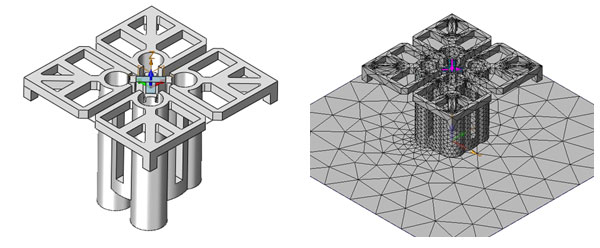
Except for optimizing the original EIT algorithm, FEM (Finite Element Method) is added in this version. It is a frequency-domain algorithm based on tetrahedral meshes, which can adapt to the irregular surfaces of 3D objects. It can simulate high-precision geometries that are electrically small and fine structures, like high-frequency array antennas, helical antennas, coaxial connectors and high-speed connectors.
For pre-processing, series or parallel Lumped Elements (RLC), including resistance (R), capacitor (C) and inductance (L) can be loaded. Field Monitors can be set for EM field and far-field that need the calculation of frequency points or bands before simulation, which can reduce the amount of calculation and accelerate simulation.
Material Library has been updated with more common and dispersion materials. Users can also customize materials and import third-party material libraries. Model Library is also available with customizable parametric models, which can be used directly anytime.
For mesh generation, users can increase the density of critical points, for example, designate them as needed and let lines of meshes pass through to control mesh generation. The quality of Yee hexahedral meshes can be checked to ensure mesh quality.
Post-processing is more user-friendly. For example, the generated simulation results can be processed again according to the input mathematical expressions. With Feature Tracking, the characteristics of results such as maximum and minimum values, bandwidth, etc. can be quickly captured, enabling users to obtain key data more efficiently.
This year, from V1.1 to V2.0, the R&D team of ZWSim-EM tackled 49 core technologies concerning solving, pre- and post-processing.
Sources: Press materials received from the company and additional information gleaned from the company’s website.

ZWSOFT (ZWCAD Software Co., Ltd.) is a world renowned CAD/CAM solutions provider. With a reputation as a committed and reliable provider of CAD/CAM software to the AEC and MCAD industries, ZWSOFT has created design software products that have…

DE's editors contribute news and new product announcements to Digital Engineering. Press releases may be sent to them via [email protected].
Follow DE
Join over 90,000 engineering professionals who get fresh engineering news as soon as it is published.






About Us · Contact Us · Editorial Team · Advertising · Privacy Policy · Subscriber Services · © 2026 Digital Engineering 24/7 · Peerless Media