Helping design and engineering professionals discover, evaluate and specify technologies and processes that shorten the design cycle and enable success.


Alert!
Digital Engineering ceased publication on July 1, 2026. This website remains available as an archive of engineering content.
For inquiries or information, please email [email protected].

Digital Engineering April 2026
In the latest issue of Digital Engineering, we take a look at the latest innovations in design for additive manufacturing, including the use of natural language inputs, social media cosplayers, and AI integration. The issue also includes a feature…

January Special Focus Issue: Design for Additive
In this Special Focus Issue of Digital Engineering, learn about the latest advancements in design for additive manufacturing, including new software tools, additive in automotive, custom medical devices, and more.
Aerospace, automotive, consumer products, medical devices, national defense and other sectors that use additive manufacturing and 3D printing technologies may benefit from quality-control software commercialized by Araqev, a Purdue University-related company.
Araqev's software helps end users print products in only a few design iterations, leading to less scrap material and machining time, the startup reports. Arman Sabbaghi, associate professor in Purdue's Department of Statistics in the College of Science, is Araqev's CEO and president.
"We estimate that the quality-control issue with additive manufacturing can lead to nearly $2 billion in global losses annually based on a model for the production costs of metal additive manufacturing systems that was developed by Baumers, Dickens, Tuck and Hague in their 2016 paper published in the peer-reviewed journal Technological Forecasting and Social Change," Sabbaghi says.
To use Araqev's software, customers upload their nominal design files and scanned point cloud data from their printed products.
"Our software uses these inputs to fit machine learning models that can simulate shape deviations for future printed products," Sabbaghi says. "Furthermore, the machine learning models enable our software to derive modifications to the nominal designs, known as compensation plans, so that when the modified designs are printed, they will exhibit fewer shape deviations compared to the case when the original designs are printed."
Araqev's algorithms also enable the transfer of knowledge encoded via machine learning models across different materials, printers and shapes in an additive manufacturing system.
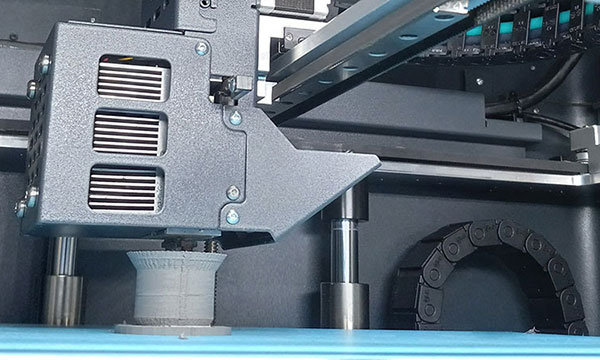
"The power and cost-effectiveness of our algorithms were most recently demonstrated via two validation experiments for the Markforged Metal X 3D printer involving 17-4 PH stainless steel products," Sabbaghi says. "Our algorithms reduced shape inaccuracies by 30% to 60%, depending on the geometry in at most two iterations, with three training shapes and one or two test shapes for a specific geometry involved across the iterations."
Araqev is establishing direct partnerships with 3D printing manufacturers and companies using 3D printers that Sabbaghi said will enable the company to scale quickly.
Sabbaghi says the company plans to establish licensing contracts after demonstrating savings and benefits available.
Araqev licensed the software from the Purdue Research Foundation Office of Technology Commercialization. The research to create the software received funding from the NSF's Cyber-Physical Systems program and CMMI EAGER program, and the Purdue Research Foundation Office of Technology Commercialization's Trask Innovation Fund. Araqev received funds from Elevate Ventures' Regional Pre-Seed Competition, Purdue's Regional NSF I-Corps program, the MKE Tech Hub Coalition Challenge and the Purdue Foundry Boost program.
Sources: Press materials received from the company and additional information gleaned from the company’s website.


DE's editors contribute news and new product announcements to Digital Engineering. Press releases may be sent to them via [email protected].
Follow DE






About Us · Contact Us · Editorial Team · Advertising · Privacy Policy · Subscriber Services · © 2026 Digital Engineering 24/7 · Peerless Media