Helping design and engineering professionals discover, evaluate and specify technologies and processes that shorten the design cycle and enable success.


Alert!
Digital Engineering ceased publication on July 1, 2026. This website remains available as an archive of engineering content.
For inquiries or information, please email [email protected].

May 2026 Special Focus: Artificial Intelligence in Design and Simulation
In this Special Focus Issue, learn about the latest developments in the integration of artificial intelligence into engineering workflows.

Design & Simulation Software Guide 2025
In this Special Issue, Digital Engineering presents its second annual guide to design and simulation software vendors.
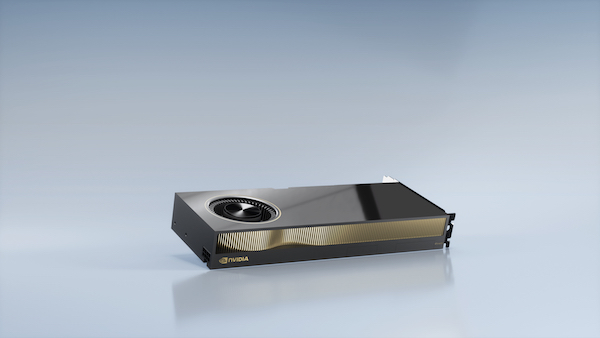
At the virtual GTC conference this week NVIDIA gave attendees a first look at the new NVIDIA RTX A6000 and NVIDIA A40 GPUs.
The GPUs are built on the Ampere architecture and feature new RT Cores, Tensor Cores and CUDA cores that can accelerate graphics, rendering, compute and AI significantly faster than previous generations.
“The ability to double or triple the resolution and vastly accelerate our real-time visualization of massive, complex building models in cityscapes with the NVIDIA RTX A6000 is super impressive,” said Paul Renner, visualization manager at Kohn Pedersen Fox Associates, one of the world’s largest architecture firms.
“Creating the next generation of passenger cars requires design perfection and a relentless pursuit of aesthetic beauty,” said Guillaume Shan, who works in Computer Graphics and Visualization Solutions at automaker Groupe Renault. “The Renault design team constantly pushes the boundaries to use every tool at our disposal. We have always relied on NVIDIA technology to review design concepts in ray-traced photorealism. The new NVIDIA RTX A6000 has exceeded our expectations and shown performance gains of over 2x with ray-traced exterior scenes. It’s quite impressive.”
Other early adopters of the new GPUs include Predator Cycling, which is evaluating the NVIDIA RTX A6000 to accelerate design processes. Performance gains of 2-6x across a number of key applications give the team the power to simultaneously run analysis, modeling and screen-sharing on a video call. Architectural design firm HKS says the RTX A6000 can enable receipt of near instantaneous feedback on design changes while running simulations in real time.
According to NVIDIA, both new GPUs benefit from the following features:
Luxion, makers of the KeyShot product visualization tool, claims that tests have show close to triple the performance using the NVIDIA Ampere architecture. The integrated benchmark in the KeyShot Viewer reached 34.7 on the NVIDIA RTX 6000 and 88.8 on the NVIDIA RTX A6000. In the upcoming KeyShot 10 release, the performance on the A6000 was even better at 95.6, which indicates the A6000 is 95.6x faster than the CPU baseline.
RTX A6000-based workstations are expected next year from BOXX, Dell, HP and Lenovo, among others, according to NVIDIA. Likewise, A40-based servers are expected from Cisco, Dell, Fujitsu, Hewlett Packard Enterprise and Lenovo.
The NVIDIA RTX A6000 will be available from channel partners including PNY, Leadtek, Ingram Micro, Ryoyo and on nvidia.com starting in mid-December. Both GPUs will be available from OEM workstation and server vendors worldwide starting early in 2021. Support for NVIDIA virtual GPU software, including NVIDIA Virtual Workstation, will be available early next year.


Since its founding in 1993, NVIDIA (NASDAQ: NVDA) has been a pioneer in accelerated computing. The company’s invention of the GPU in 1999 sparked the growth of the PC gaming market, redefined computer graphics, ignited the era of modern AI and…

Cut Retrieval-Augmented Generation (RAG) Hallucinations by 50%
Most teams hit the same wall with enterprise AI: LLMs that hallucinate, pipelines that don’t scale, and infrastructure that’s harder to design than the models themselves.

DE's editors contribute news and new product announcements to Digital Engineering. Press releases may be sent to them via [email protected].
Follow DE






About Us · Contact Us · Editorial Team · Advertising · Privacy Policy · Subscriber Services · © 2026 Digital Engineering 24/7 · Peerless Media