Helping design and engineering professionals discover, evaluate and specify technologies and processes that shorten the design cycle and enable success.



Digital Engineering April 2026
In the latest issue of Digital Engineering, we take a look at the latest innovations in design for additive manufacturing, including the use of natural language inputs, social media cosplayers, and AI integration. The issue also includes a feature…

January Special Focus Issue: Design for Additive
In this Special Focus Issue of Digital Engineering, learn about the latest advancements in design for additive manufacturing, including new software tools, additive in automotive, custom medical devices, and more.
Though 3D printing has been used for prototyping for decades, many users now actively use the technology to churn out production-grade and end-use parts. Such parts made via additive manufacturing methods have real-world application in industries ranging from medical to outer space and everything in-between. These parts often must meet industry-specific standards, may require certain mechanical properties (such as strength), are made of durable materials that may need to withstand high temperatures, are consistently produced, and may require post-processing.
DE contacted several additive manufacturing companies to gain insight into the subtleties of manufacturing production-grade and end-use parts, what technologies are in play for said parts along with a sampling of functional applications, and what challenges still exist, alongside future possibilities.
Materialise has worked with 3D printing for 35-plus years, starting with prototyping. “From the beginning, we recognized that the potential of additive manufacturing (AM) goes far beyond prototypes,” says Gert Brabants, business line manager Series Manufacturing, Materialise Manufacturing.
“Over the years, we’ve developed software, processes and even hardware that have enabled us to move to certified, production-grade manufacturing. By collaborating with regulatory authorities and helping to create industry standards, we’ve ensured that AM can meet the strict requirements of highly regulated industries,” Brabants says.
Fabian Alefeld, director of Global Additive Minds Academy, run by veteran 3D printing company EOS, says in the early stages of 3D printing, it was used for modeling and prototyping. “However, the landscape has changed drastically, and AM has matured into a high-quality industrial manufacturing technology.”
Mike Baker, global head of brand and communications at Formlabs, acknowledges that though 3D printing has played a role in prototyping and production parts from the get-go, mass production is more recent.
“Mass production of 3D printed parts for end-use applications has become much more common in just the past few years, thanks to improvements in printer cost and reliability,” Baker explains.
“3D printing offers a new way of manufacturing end-use parts, and one that could transform the way we make more customized and personalized goods for consumers. Our innovative customers from around the world have already used the Fuse 1 and Fuse 1+ 30W to create end-use custom orthotics, gaming controllers, seat components in the BMW X7 and more.”
At Formlabs, Baker says the 3D printing technology most used for production-grade or end-use parts at scale is selective laser sintering (SLS). “SLS 3D printers are particularly well-suited to operating at scale because they are more efficient, not less, when operating at high throughput, across material use, printer uptime and operator labor.”
At Materialise, Brabants says the technology used in its manufacturing facilities is application-specific. For plastics applications, Materialise relies on fused deposition modeling, selective laser sintering and Multi Jet Fusion, while for metals, the company turns to selective laser melting.
“Each technology has its strengths, allowing us to produce high-quality, production-grade parts at scale,” Brabants says. “It’s also important to note that additive manufacturing technology is just one part of the puzzle. Beyond the printing technologies themselves, software plays a critical role in ensuring consistent quality and reliability. Post-processing and quality control are also essential. By integrating all these elements, we provide not just 3D-printed parts but complete solutions for industries like aerospace, medtech and beyond.”
The process of manufacturing production-grade parts falls into one of three categories, according to Patrick Dunne, vice president of Advanced Applications, 3D Systems: direct metal printing; direct plastics; and in the middle—indirect workflow.
“It’s interesting that the maximum bulk volume of additive manufacturing production applications are in the middle zone, which is the indirect manufacturing method,” Dunne says. For example, in the manufacture of investment castings, 3D Systems has customers making millions of castings every day via indirect methods.
“It’s mass production of sacrificial patterns. So they’ll 3D print a wax or polymer pattern versus injection molding and then feed that into their investment casting process. That’s how they make things like wedding rings and rockets,” says Dunne, who refers to the indirect method as “hybrid,” because the process combines additive with traditional formative to produce something.
There are extensive production applications in metals and plastics, Dunne notes. “Metal provides functionality that directs it almost exclusively to production. If you look at some of the first applications that emerged in metals, there was a lot of attention on things like brackets. The lightweighting of brackets in aerospace was one of the original applications,” he says.
Fast-forward to today, and one production-grade application acutely familiar to 3D Systems is that of the spinal fusion cage used in the orthopedic industry. “Direct metal printing through fiber laser melting of titanium alloys has become the standard mode of manufacturing now for spinal fusion cages,” Dunne shares. “We directly, along with our customers, produce hundreds of thousands of spinal fusion cages in titanium every year.”

Unique about these implants is that they are not custom nor patient-specific. “They’re using additive because it’s faster, better, cheaper,” Dunne says. “You can create intricate lattice structures using additive, which provides a significant functional and clinical benefit to the patient. This drives osseointegration.”
The economics are better too. “You can produce a spinal fusion cage using a fiber laser melting printer with better economics than you can using CNC machining, hogging out billets, and going through multiple coating processes,” Dunne says.
Alongside custom workflows for applications such as skull and maxillofacial reconstruction plates, there are also applications such as the spinal cage example that represents what 3D Systems calls mass series production. “It’s not a custom workflow. They are producing hundreds of thousands of implants with some size and shape variants. But they’re not specific to the target patient,” Dunne explains, noting an abundance of similar applications in the medical space.
But medical applications represent one of many functional examples of industry innovation. “Moving beyond medical into other segments, we see a lot of direct metal printing in the semiconductor tooling industry. If you were to climb into one of those extreme UV-generating lithography machines, for example, what you’ll find is that there are dozens if not hundreds of components that are produced using the same technology—fiber laser melting,” Dunne shares.
“Additive manufacturing is playing a unique role right now in facilitating smooth flow of cryogenic cooling fluids within ultra-high precision systems like lithography systems. Additive is interacting with all of those physical phenomena by allowing designers and engineers to create very exotic highly optimized shapes, essentially,” Dunne shares.
“Every industry where there is physics [presents] an opportunity for optimization,” he continues. As an example, “If you’re a designer at the very front line of trying to optimize or improve the performance of a radar, you have a tool in the toolbox that allows you to create super exotic antennas and wave guides.”
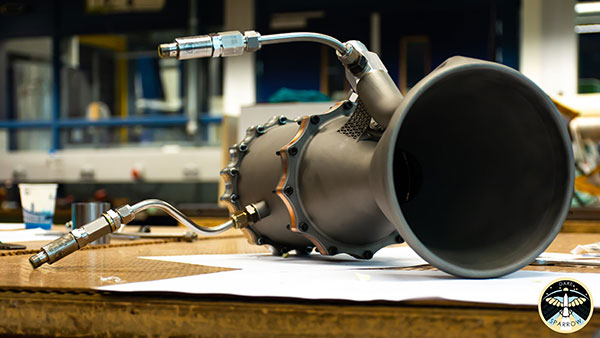
EOS’ Alefeld concurs with the broad range of additive-driven applications. “As mentioned, all major space companies utilize AM for critical rocket engine components. Titanium hip implants have become the new standard in medical applications, while the U.S. Navy is heavily investing in AM for casting replacements on submarines.”
Alefeld continues: “Gas turbines already leverage AM for more efficient fuel injectors, swirlers and other engine components. AM die-casting tools are gaining traction due to their superior performance and productivity. Even the sporting goods industry is embracing AM, with Wilson reimagining applications such as the basketball.”
As for obstacles impeding use of 3D printing for production cases, it depends on who you ask.
Formlabs’ Baker says the greatest challenge is company mindset. “Most organizations are stuck with rigid and expensive manufacturing technologies because they don’t have the resources or information to feel comfortable switching to newer technologies like 3D printing. These organizations have been using the same manufacturing processes for decades, and it requires forward-thinking change management policies to adopt new ways of doing things,” he says.
Materialise’ Brabants adds, “One of the biggest hurdles in producing production-grade parts with AM is a lack of industry-wide knowledge and standards. They lack design handbooks, databases and norms, which makes adopting AM a risk, especially for highly regulated industries like aerospace and MedTech. Without sufficient data to ensure reliability and consistency, companies hesitate to make the switch from traditional manufacturing.”
Another major obstacle Materialise notes is post-processing. “While 3D printing itself can be efficient, manual post-processing often becomes a bottleneck, limiting scalability and increasing costs. Automation in post-processing is crucial for achieving the speed and cost-effectiveness needed for large-scale production,” Brabants adds.
At EOS, Alefeld sees the challenge as workforce-driven. “Many engineering teams, aside from those already leading in AM adoption, lack a comprehensive understanding of the current capabilities of AM technologies.”
To bridge the gap, Alefeld notes that EOS launched the Additive Minds Group—an engineering and training team intended to “successfully implement AM through training, co-engineering, and turnkey solutions.”
The ability to create production-grade parts at scale “empowers companies to innovate in ways traditional manufacturing simply can’t match,” Materialise’s Brabants says.
But what really matters, according to Brabants, is using additive manufacturing “where it solves problems. Any industry that relies on low-volume production will benefit from additive manufacturing, for example. We’re on our way to producing our 150,000th component flying onboard an Airbus A350 passenger jet this year; a great example of where AM adds value—by simplifying supply chains and reducing lead times while still meeting strict certification requirements,” Brabants says.
Dunne views additive manufacturing of production-grade parts as one of many tools to consider when navigating the production process.
“When you open the toolbox, you have injection molding, thermoforming, vacuum forming, CNC machining [and so on]. And you have hundreds of different ways to make things—formative, subtractive and now additive has become another tool in the toolbox. It’s relatively easy to calculate if it makes sense or not,” Dunne says.
Basically, according to Dunne, where physics is at play, there may be “a really good fit” for additive. “So if you look at any industry with extreme physics whether it’s CT machines, nuclear power stations, industrial gas turbines, jet engines, rocket engines, semiconductor equipment, you will find that there is rich hunting ground for additive,” Dunne says.
EOS’ Alefeld adds, “Today, nearly all industries can benefit from AM for production parts,” sharing how AM offers two key advantages—design freedom and supply chain flexibility. Design freedom “leads to enhanced part performance, weight reduction and simplified assembly processes;” whereas supply chain flexibility “reduces lead times, eliminates minimum order quantity constraints and minimizes reliance on physical inventory by enabling digital warehousing.”
Note the shift from prototyping to series manufacturing, Materialise suggests. “Additive manufacturing is becoming a key part of production, moving beyond innovation to deliver real, impactful solutions. It’s not just about creating powerful tools based on what we know about AM—it’s about empowering our customers to succeed based on their expertise in their industries,” Brabants says.

Baker at Formlabs predicts materials performance and a larger automated ecosystem will influence the future of AM production-grade and end-use parts.
The outlook is bright at EOS as well: “We expect AM to continue driving innovation in established sectors like space, medical and oil & gas, while also expanding into emerging fields such as nuclear energy, robotics and autonomous vehicles,” Alefeld says. “While AM has reached technological maturity, its adoption is still in its early stages. We anticipate significant growth in the coming years as more industries recognize its advantages and integrate AM into their production processes.”
Dunne of 3D Systems also expects industrial adoption to grow. “Industrial adoption and industrial application since the invention of 3D printing has been a gradual but very continuous ramp up into more and more applications. It’s certainly gotten a lot easier and faster and better in the last 10 years since additive became more well known. I work with engineers now who have grown up in a world where 3D printing has always existed and they just assume that it is just another tool in the toolbox.”

Materialise is headquartered in Leuven, Belgium and has branches worldwide. We've been playing an active role in the field of Additive Manufacturing (AM) since 1990. In addition to having the largest single-site capacity of AM equipment in…

Stephanie is the Associate Editor of Digital Engineering.
Follow DE
Join over 90,000 engineering professionals who get fresh engineering news as soon as it is published.






About Us · Contact Us · Editorial Team · Advertising · Privacy Policy · Subscriber Services · © 2026 Digital Engineering 24/7 · Peerless Media