Helping design and engineering professionals discover, evaluate and specify technologies and processes that shorten the design cycle and enable success.


Alert!
Digital Engineering ceased publication on July 1, 2026. This website remains available as an archive of engineering content.
For inquiries or information, please email [email protected].

Digital Engineering April 2026
In the latest issue of Digital Engineering, we take a look at the latest innovations in design for additive manufacturing, including the use of natural language inputs, social media cosplayers, and AI integration. The issue also includes a feature…

January Special Focus Issue: Design for Additive
In this Special Focus Issue of Digital Engineering, learn about the latest advancements in design for additive manufacturing, including new software tools, additive in automotive, custom medical devices, and more.
At conferences and corporate events, you collect cups and T-shirts with company names and brand logos. In expensive jewelry stores, you wait as the staff engraves your name or initial onto your latest purchase, either at a modest cost or no cost at all.
Beyond the self-aggrandizing personalization, a new kind of personalization is on the rise. Custom-fitted surgical masks for doctors on the frontline in the battle against COVID-19, tailor-made glasses for patients with abnormal cranial structures, tools that fit a specific worker’s hand—these personalized products offer ergonomic benefits that go beyond simple aesthetics. In many cases, they are driven by affordable 3D printing and digital scanning at the click of a smartphone.
Jesse Chang’s wife and brother are physicians. When he heard that the hospital staff had been cleaning the typically disposable N95 masks with Lysol for reuse due to a personal protective equipment shortage, he sprang into action. His efforts helped launch the MyMask Movement, an online portal for making custom-fitted surgical marks.
“If you have the luxury of using a fresh mask with every patient, that’s what you do, but that’s rarely the case. Many doctors are now putting another mask over an N95 mask to extend its shelf life,” says Stanley Liu, M.D., assistant professor of otolaryngology, and plastic and reconstructive surgery, Stanford University School of Medicine. He is also part of the MyMask team.
3D-printed face shields have been getting a lot of publicity as examples of crisis-driven ingenuity, but Chang, who was a venture capitalist in additive manufacturing (AM) startups, felt the technology is misused. “It shows 3D printing can step in as a stop-gap solution, but in the long run, injection molding probably makes more sense,” he reasons.
In Chang’s thinking, the technology’s personalization potential invites another use case: producing tailor-made masks, each a snug fit for the individual physician’s unique face.
“With the technology we had three years ago, we could not have done this type of mass personalization with reliable, consistent results,” says Chang. “What made it possible are the advances in stereolithography technology, powder bed fusion, and the HP Multi Jet Fusion and EOS machines we use primarily for production.”
The MyMask project taps into the depth-sensing camera in iPhone 10 and newer models, allowing users to easily scan and upload their face geometry. It is the same face ID technology employed by iPhone 10 to let you unlock your phone with your face. The project’s algorithm-driven generative design software automatically converts the user-supplied geometry to produce the 3D-printable file.
“It’s really about comfort. With a standard N95 mask, the nasal region has a lot of air leaks. The metallic clip hurts your nose bridge, and it doesn’t conform to the contour of your face,” explains Liu.
To be reusable, the masks need to be able to withstand autoclave sterilization, a requirement for surgical equipment in hospitals. The mask designed by MyMask has been submitted and reviewed by the National Institutes of Health. It has received emergency use authorization, the organizers state.
MyMask’s partners include MSC Software, part of Hexagon Software, which offered the team computational fluid dynamics simulation help to test the mask design.
Stanley Black & Decker (SB&D) is the company behind many instantly recognizable products, from the Black & Decker vacuum cleaners and power drills to the Hugs baby monitoring devices. According to Marty Guay, VP of business development, SB&D relies on additive manufacturing (AM) or 3D printing for building prototypes and assembly aids, among others.
Paired with generative design technology, AM is a way to rethink solid parts for lightweighting. “Parts that used to be solid throughout can now be produced with honeycomb structures,” Guay notes.
The company is now partnering with Connecticut-based Techstars that runs an accelerator program.
“The program gives us a chance to recruit from the startups that self-identify as AM companies,” says Guay. “We pick the ones we can learn from, can drive new conversations within our company and can identify new use cases. In just a short time, we really got a good understanding of what’s happening in AM.”
Companies accepted into Techstars receive a 90-day mentor-driven program, office space and access to potential investors. One selected participant is ManiMe, founded by Stanford MBA students Grace Chiang and her friend Jooyeon Song. The startup uses photogrammetry to configure nails that perfectly fit the customer’s fingers. It uses 3D printing to produce the individualized nail sets.
“We look at them to learn how they customize the nails using the photos their customers send in,” says Guay. “That concept may lead us to, one day, produce tools that fit the customer’s hands perfectly.”
Other Techstars participants include Ireland-based CALT Dynamics, which uses 3D printing to produce custom parts; and Triditive, which develops metal AM system for volume production.
Patrick Dunne, VP of advanced application development, 3D Systems, identifies health care as the primary sector for AM-driven personalization. The reason is obvious: the unique body types found across the human population.
“Certain medical devices yield better results when they have custom, conformal fit,” he observed. “AM is infinitely flexible as a production tool in the sense that you have no tooling. Your digital design is your tooling. Reinforce that with the ability to scan and digitize objects, [and] AM can yield continuous custom outputs.”
Orthopedics and medical implants, Dunne points out, are good examples of AM-driven personal health care offerings. Ancillary uses include producing surgical models and guides.
“The dental industry is essentially the largest custom spare parts replacement industry,” Dunne quips. “Everything is made to order based on the way a patient bites, chews and eats.”
The variety of printing materials now available, from polymer-based clear materials for nightguards to ceramic for implants, make AM a viable option, points out Scott Drikakis, healthcare segment leader, Stratasys Americas.
Although certain finished products, such as dental crowns, cannot yet be 3D printed due to the limitation in material science, “the process of making the crown can still benefit from 3D printing,” Drikakis points out.
“Depending on the application, the materials need to comply with ISO 1099 standards, meet various biocompatibility and sanitization standards, and pass testing protocols. The longer the implant remains in the body, the more rigorous the requirements are,” Drikakis says.
In the last five years, he’d started to see 3D-printed orthopedic implants: “knees, hips and shoulders, you name it,” he adds.
Another emerging additive manufacturing use is in corporate and luxury jet manufacturing, where the buyer tends to want logos, crests and personal identities integrated into the airplane’s interior. From coat hangers and coffee cups to plates, anything is up for personalization in this sector, Dunne notes.
In high-end markets, custom jewelry is on the rise, Dunne says. The online jeweler Stuller, for instance, uses 3D printing to make engagement rings, graduation rings and anniversary pendants with your chosen text or message. Stuller, in fact, offers several Asiga MAX 3D printers in its catalog, under jewelry casting supplies.
“Jewelers like Cartier, for example, uses our DMP (direct metal printing) systems to produce gold bezels for watches or pen cases,” says Dunne. “Filling 3D printers with gold dust, as you can imagine, is a very niche market, so that’s an exception. The primary use of AM in jewelry is for printing the sacrificial wax.”
After getting our eyes tested, most of us can point to a readily available frame in the optometrist’s office to get our eyeglasses made. But it’s not so easy for those with craniofacial anomalies, which calls for custom-fitted frames.
Loving Eyes Foundation found a way to help such customers using Carbon’s digital light synthesis technology. In early cases, the foundation used computed tomography and magnetic resonance imaging to reconstruct the 3D model of a child’s head, then used a Carbon printer to 3D-print the glasses. The RPU 70 resin used for the project passes biocompatibility tests for sensitization, irritation and cytotoxicity, Carbon states.
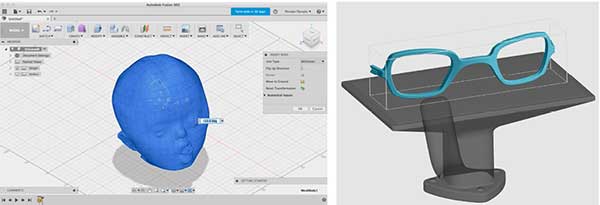
Loving Eyes Foundation uses magnetic resonance imaging and computed tomography scan to reconstruct a patient’s head, then 3D-print custom eyeglasses. Image courtesy of Carbon.
Resolution Medical, a medical device maker, is a partner in the project. “With a technology like Carbon, we are able to quickly iterate on designs that can have a direct impact on improving the quality of a child’s life,” says Shawn Patterson, founder and president, Resolution Medical.
Today, the process is much simpler. The head scan is done with a smartphone via photogrammetry. “There are many promising developments for buyers to do the scans themselves via smartphones they already own. MyFit Solutions in France is using smartphone scanning to make ear tips personalized with 3D Printing,” says Dara Treseder, chief marketing officer, Carbon.
For large-scale production, Carbon printers’ connected nature offers an advantage. “Digital designs for parts can easily be updated, shifted and manufactured as needed for any design or part,” says Treseder.

From digitization, design and simulation through manufacturing, inspection and management, our comprehensive portfolio of technologies provides a seamless, customizable workflow designed to optimize products and processes while accelerating…
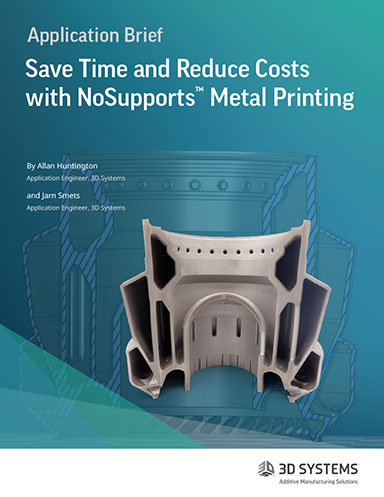
Save Time and Reduce Costs with NoSupports™ Metal Printing
Metal 3D printing is a high energy process in which it is possible for unmanaged heat and stress to build up and impact part quality, this guide presents a step-by-step methodology for how to apply NoSupports to a hot end section of a larger turbomachinery part.

Kenneth Wong is Digital Engineering's resident blogger and senior editor. Email him at [email protected] or share your thoughts or suggestions at digitaleng.news/facebook.
Follow DE






About Us · Contact Us · Editorial Team · Advertising · Privacy Policy · Subscriber Services · © 2026 Digital Engineering 24/7 · Peerless Media