Helping design and engineering professionals discover, evaluate and specify technologies and processes that shorten the design cycle and enable success.


Alert!
Digital Engineering ceased publication on July 1, 2026. This website remains available as an archive of engineering content.
For inquiries or information, please email [email protected].

Digital Engineering April 2026
In the latest issue of Digital Engineering, we take a look at the latest innovations in design for additive manufacturing, including the use of natural language inputs, social media cosplayers, and AI integration. The issue also includes a feature…

January Special Focus Issue: Design for Additive
In this Special Focus Issue of Digital Engineering, learn about the latest advancements in design for additive manufacturing, including new software tools, additive in automotive, custom medical devices, and more.
As the coronavirus outbreak accelerates around the world, large hospitals in the U.S. scramble to maintain a steady supply of personal protective equipment (PPE) for the medical staff.
This week, 3D printer maker Stratasys launched a project to help fill the gap in PPE production. The company's first goal is "to deliver an initial 5,000 [face] shields to critical need locations over the next week."
Disposable face shields, such as those from the vendor Safety Supply America, are designed to protect medical staff from infectious droplets and toxins when treating patients.
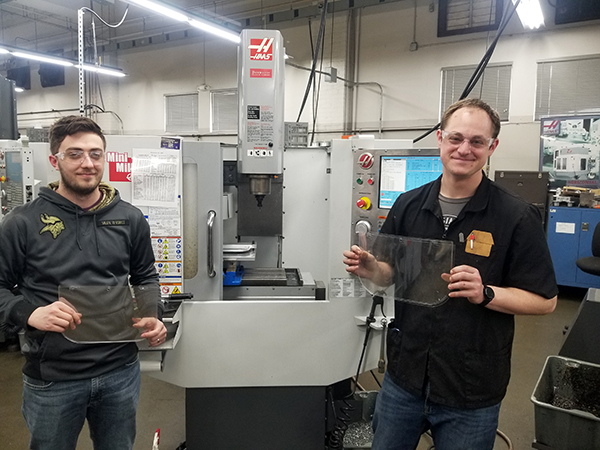
"Stratasys is rapidly scaling its efforts to print both reusable and disposable face shields on dozens of FDM 3D printers located in Texas, California, and Minnesota. These shields have FDM 3D printed frames, with clear, full-face plastic shielding," the company writes in its dedicated page for COVID-19 response.
To put its plan into action, the company is calling on 3D printing shops and service bureaus with volume-production capacity.
It also has an online form for institutions to request shipments of easily assembled protective shields.
The face shields are the most immediate needs Stratasys plans to tackle, followed by face masks and medical components that can be 3D printed.
"From what we've heard, everyone is willing to step in and help in whatever capacity they can," said Scott Drikakis, Healthcare Segment Leader for Americas, Stratasys. "Even small desktop printer [owners] are now starting to print face shield visors. Some went so far as to procuring transparent films to produce homemade face shields, then donating them to hospitals."
What Drikakis and his team now need to figure out, is coordination and scaling.
While 3D printing doesn't need the complicated and costly setup of a machine shop, its volume production capacity is lower. Desktop 3D printers owned by individual engineers and hobbyists can "churn out one to two [face shields] every two hours," estimated Drikakis Hence, the importance of coordination.
This is where the company's industry partners may be able to add great production muscle to churn out more units per hour, per day. The thermoplastic materials supply is robust, according to Drikakis, but materials for the transparent shield may be limited. "We're keeping a close eye on that," he added.
For 3D printing, the hardware owner needs the 3D file of the desired object, usually in STL format. Stratasys is also providing it.
"The design that Stratasys put out is for standard 3-hole-punch assembly. It works with most FDM or FFF 3D printers," said Drikakis. "Some people have been just going to OfficeMax or Office Depot and buying transparency films -- standard 8x11 sheets -- with three hole punches to attach them to the 3D printed frame," he explained.
Inexpensive 3D printed parts played a crucial role in bridging the respirator valve shortage in Italy, one of the European countries hardest hit by the virus outbreak.
As reported by Forbes, Isinnova's Christian Fracassi and Alessandro Romaioli, cofounders of an Italian engineering startup, "reverse-engineer a 3D-printed version of the official part. Called a venturi valve, [which] connects to a patient’s face mask to deliver oxygen at a fixed concentration, it connects to a patient’s face mask to deliver oxygen at a fixed concentration."
The production cost via 3D printing was roughly $2-$3.
CRP Technology, an Italy-based 3D printing firm, is also joining the rush to produce Charlotte valves, the linking component in ventilator masks.
The National Additive Manufacturing Innovation Institute, known as America Makes, has started a repository of service providers and members who are in a position to help manufacture critical parts.
3D Systems, another 3D printer maker, has launched a decicated page for COVID-19 response. The company is pledging to support medical device manufacturers and point-of-care hospitals. "The company is offering its expertise, services and production capacities as needed. Depending on the scope of the engagement, charges may be incurred, but the company is managing this on a case-by-case basis," according to 3D Systems' PR department.
This week, 3D Systems added a downloadable ready-to-print face shield frame to the page.
"Even though many individuals and groups are designing and manufacturing face shield frames for these responders, many of the designs are not optimized for high-density optimized additive manufacturing and cannot be accessed locally," it notes. The design it offers is "optimized for high-density nesting" and intented to be printed in "medical-grade nylon that is autoclavable and compatible with disinfectant cleaners," it clarifies.
Carl Bass, for CEO of Autodesk, has lately been spending more time in his machine shop. He been making hundreds of face shields, using polycarbonate sheets mounted on standard baseball caps, at a cost of $1 each. He has started delivering early batches to hospitals, he announced in is twitter feed.
These are the face shields we made at use in a local ER. We were able to make 500 more today as well as source material for thousands more. We are all very lucky to have such courageous and dedicated people working in our hospitals pic.twitter.com/ktzH8dnNB1
— Carl Bass (@carlbass) March 29, 2020A
A team from MIT has developed an open-source low-cost ventilator that can be rapidly deployed. The inventors called it MIT E-Vent (Emergency Ventilator).
The team, called MIT E-Vent (for emergency ventilator), was formed on March 12 in response to the rapid spread of the Covid-19 pandemic. https://t.co/cmFqei96Gf pic.twitter.com/8lpQeJ1XQS
— Massachusetts Institute of Technology (MIT) (@MIT) March 29, 2020
Similarly, Syracuse University faculty, alumni, and staff have also begun producing 3D-printed face shields, using the School of Architecture's digital design and production facility. The facility used the Lulzbot Taz 6 (an open-source 3D printer from MatterHackers), Gigiabot 3+ (from re:3D), and Zortrax M300 printers to churn out shields. According to the story published by the university, the team can produce 60-90 face shields per day.
For more on our COVID-19 news items, please go to our dedicated section.



Every day, our customers find simpler, smarter approaches to stubborn design problemsand greater confidence to confront towering human and technological challenges. Less hindered by the usual constraints, they can imagine, design, iterate and…
Rapid Prototyping in The Automotive Industry
Henry Ford may not have invented the automobile, but his pioneering spirit did transform the way cars were made. His assembly line process drastically reduced costs with standardized parts and greater efficiency which led to lower cost, higher quality and greater reliability.

Kenneth Wong is Digital Engineering's resident blogger and senior editor. Email him at [email protected] or share your thoughts or suggestions at digitaleng.news/facebook.
Follow DE






About Us · Contact Us · Editorial Team · Advertising · Privacy Policy · Subscriber Services · © 2026 Digital Engineering 24/7 · Peerless Media